Showing posts with label MaxMSP. Show all posts

Thursday, 9 June 2011

A much overdue post...

...it's been a busy past couple of months for myself and now that I've had time to relax a little I thought it was probably about time I posted a little update here too:

I have now finished my degree at the University of Hull and will be graduating next month. With all of the marks I've had thus far I am still on track for a first class finish so here's hoping that's still the case when I receive my final set of marks in about three weeks.

What next? Following an interesting talk given by Atau Tanaka last month, I have been inspired to further explore new concepts of audience and artist relationships with a particular focus on technology and interactivity (my key area of interest after 3 years of studying). I think a masters course that allows me to work within this field is what I shall be pursuing, so long as funding permits!

In terms of current and recent projects, I realise that my website is now due an update too and hopefully this will happen at some point in the next couple of weeks. To give a idea of what I've been up to since my last post:

Back at the end of April, I went to Germany with my traditional folk group Frozen Gin. We played a very enjoyable set to one of the most welcoming crowds I have ever had the pleasure to perform to and made some great friends who I hope to see again! Gleichen zeit im nächsten jahr? Studio recordings of some of the tracks we played that night are also available to download here.

Around the time we played that concert I also got my hands on a new iPad and have been having plenty of fun it. Having made plentiful use of apps like TouchOSC in the past on smaller iDevics I've been experimenting with some ideas, creating some new MaxMSP patches to use it with. One of those which I have pursued a little further I have decided to call PhatPad (or I should say 'had'):
WIP icon and WIP title for my latest creation.


It turns out someone has already made a completely unrelated app called PhatPad so this probably won't be its final name, however the concept is something that's proved to be quite useful. Given the restricted number of dials on my Moog Little Phatty (yes I have far too much gear) I decided to make a TouchOSC/MaxMSP combination that allows more flexible control utilising multiple faders and XY pads etc. I also get semi-wireless control (the iPad communicates with the MaxMSP patch over wi-fi which passes along MIDI messages to the Moog) which is especially useful given that I've been building in a mini-sequencer too!

I'll get some videos posted of that as soon as I've done some more work on it. With all the more pressing work I've had to complete since I got the iPad, I've not had much chance to look at it since I first worked on it!

I've probably missed something but I've got far more time on my hands now so updates should come a little more quickly (I hope). Additionally, from the end of this month I'll be based in Manchester. Fancy that!

Monday, 3 January 2011

Guitar Synth Project - Changes

It's been a while since my last post about my guitar synthesiser project 'Strat-O-Synth'. In the past few days I've made some final changes to the project. To start with, it's now called 'Jag-U-Synth'. For quite a while after my early experiments with squeezing in electronics I've been working with having the Arduino controller in an external enclosure to be attached to the back of my Fender Jaguar.

Additionally, Arduino control is something I've scrapped. The controller pictured below is now an image of what might have been, as I have detailed in my accompanying documentation, my own limited electrical skills have meant that throughout this project, durability and quality of my  home electronics have not been up to the standards I might have hoped for. As a result, to make sure I still get the most out of this project that I can, with what I see as a small amount of compromise, I have decided to incorporate iPhone control once again. Whilst keeping the level of tactile expression given by using the guitar, having a controller that offers flexibility, ease of modification, expressive options, stability and reliability in a small lightweight device that has wireless functionality, using a customisable touch screen environment is arguably the more sensible option for a project such as this, at least until more experience in the various custom hardware options can be gained by myself. Had I had a longer time frame in which to work, I would have pursued the Arudino hardware further, it's still something I'll definitely use again in the future.

I'll be posting a video of the synth in operation as soon as possible, as part of the University assignment submission I'll be creating a short video demonstrating how the program works. Stay tuned for more news of my other current projects too, 2011 should be a busy year.


Images:

The hardware in its most complete state. As well as 3 potentiometers, a movable FSR was also part of the project, all with switchable control functionality.
How the original program used to look, tying in with the hardware controller.

The iPhone attached to the Jaguar, positioned for easy changing of parameters when playing.
The updated program GUI, designed to match the style of the TouchOSC controller.

Thursday, 2 September 2010

Guitar Virtual Instrument Project - Part 1 - Squeezing It All In

It's time for an update on my latest project! I have decided to work on both hardware and software of this project simultaneously in the run-up to next semester, however my primary focus is on completing the hardware controller side first. By doing this, the software can carefully be fine-tuned and adjusted without me having to worry about incomplete or changing hardware!

Since my last post I've acquired all of the components I plan to use in this project:

3 Potentiometers - to be multifunctional and control various parameters

1 Ribbon Potentiometer - for controlling assigned groups of parameters in unison

1 Force Sensitive Resistor - to acts as a pressure sensitive expressive control over parameters such as pitch-bending and filter cutoff

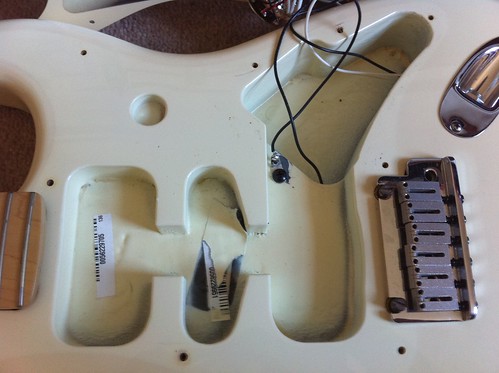
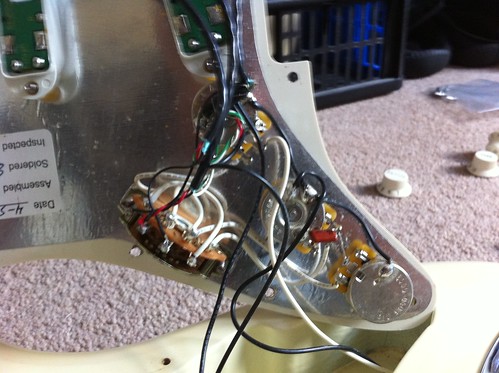
After getting hold of all of these parts, as well as various extra tools and guitar related items, yesterday I finally embarked on the modification of the guitar. This brings me to the next step of the project, solving logistical issues. The principal issue so far concerns space: there's not a lot of it. This can be seen in the photos of the Stratocaster cavity and existing components below:
Limited space in the control cavity.

Limited room around existing components.
Given that I've already made the decision to make this a minimally invasive modification, drilling into or sawing at the guitar body is a no-go, therefore careful measurement has been required so far to determine what I can get in there!

As it is, the Arduino Duemilanove simply won't fit easily enough into the control cavity, therefore I will be opting to mount it to the back of the guitar in some form of case. The wires between the Arduino board and the components that will fit into the guitar will run together out of an additional hole in the scratch-plate to the board. Inside the guitar will be a cut-down prototype board with any additional components attached - resistors etc. - which will be connected to the the power and the ground on the Arduino, as well as the main controls attached to the scratch-plate.

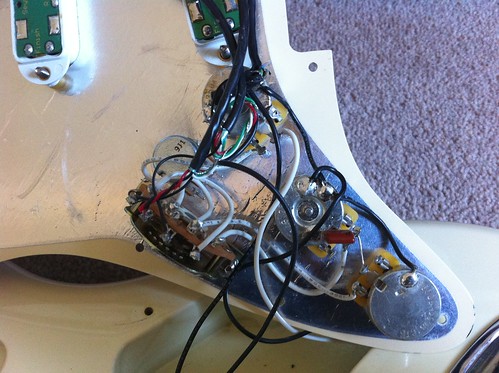
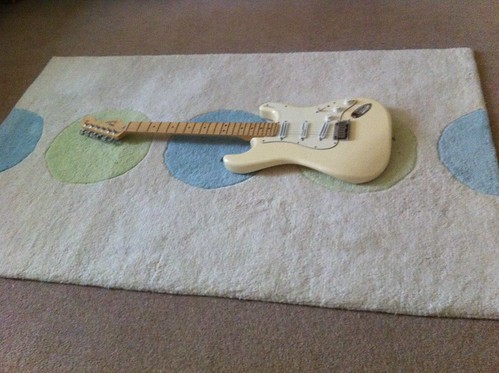
Having decided how everything will be integrated into or onto the guitar, I have started the task of measuring out where all the components will fit and begun attaching them. The very first potentiometer has been mounted on the scratch-plate and can be seen in the photos below. Over the coming days I will set to work adding the others, checking the suitability of their positions, then adding all the necessary wires. Stay tuned for Part 2.
The first potentiometer squeezed in (to the bottom-left of the topmost existing pot).


One down...stay tuned for further updates!

Monday, 16 August 2010

New Project - Virtual Instrument With Guitar Control

Hi there, I thought it was about time to make my first official post on my blog and outline my plans for a new project! Here goes:
Some hardware I'll be using in my new project!

For the final year of my degree beginning this Autumn, I've once again chosen a module that focuses on creating and utilising alternative and interesting forms of interactive music performance (or composition, art installations etc.). Following the success of my 'iTouch Synth' (Mac application available here!) I have again decided to design and create a virtual instrument, with an alternative method of control.
iTouch Synth'
 In the accompanying documentation for 'iTouch Synth', I stated that the limitations encountered in my previous computer music projects - the projects I have created in MaxMSP - had arisen due to a necessity to map my own creations to another person's i.e. my software patch to a their hardware controller. With this in mind, I found using the customisable environment of the iPod application TouchOSC liberating, given that I could custom fit my own controls to software patch.
I love my MIDI controller, but it has its limitations.
 As much as I enjoyed and was pleased using this customisable touch-screen control - which I will continue to use in the future - I couldn't help but long for the feeling of tactile controls! It was this longing and a hypothetical idea for expanding the capability of existing instruments that brought me to my latest project idea.
iPod Touch - too flat!
 At this stage, my basic plan is to have a virtual instrument - a synth or sampler, possibly a hybrid - that is played using my electric guitar - with frequency and amplitude tracking etc. Alongside this I plan to employ hardware controls for adjustment of software parameters. Rather than using my current MIDI controllers, iTouch or investing in a floor-controller, I've instead decided to have integrated controls on and within my electric guitar, using the open-source hardware Arduino.

My Arduino Duemilanove and breadbord.
So far my experiments have covered FFT frequency tracking and re-synthesis as well as endless breadbord prototyping of the hardware but the project is developing quickly! Stay posted here in coming weeks for information on this developing project!
Some of the components to be added to my guitar.